Wednesday, December 27, 2023

1700 Days: Kill the Bear

          On the 1,729th workout without a rest day I completed a personal record squat set of 185 pounds for 76 reps. This post describes the process I employed to achieve that set and many others along the way. I hope you find this post helpful so that you too can achieve rep max personal records in any lift of your choosing. 

Watch it now if you haven't seen it.

            One of my favorite movies is "The Edge.” Released in 1997, it is a thrilling tale of survival starring Anthony Hopkins and Alec Baldwin. The story revolves around two men, Charles Morse (played by Anthony Hopkins) and Bob Green (played by Alec Baldwin), who find themselves stranded in the remote wilderness of Alaska after their plane crashes. Charles is a wealthy and intelligent billionaire, while Bob is a young and charismatic fashion photographer. The opening scenes portray Charles as reserved and intellectual, while Bob is impulsive and superficial.

The men struggle to survive in the harsh and unforgiving Alaskan wilderness as tensions between them rise. They soon discover that they are not alone. A massive and cunning grizzly bear begins stalking them, pushing them to their limits.

The movie explores themes of human instinct, the will to survive, and the thin line between the comforts of civilization and savage nature.

As Bob's will is fading, Charles provides one of the most powerful quotes of any movie. In this most memorable scene he is convincing the younger Bob that they will kill the bear and live.

Charles: “Do you believe it, Bob? Believe it?”

Bob: “I don’t know Charles.”

Charles: “Ah?”

Bob: “I don’t think it’ll work Charles.”

Charles: “It will work!”

Bob: “No.”

Charles: “It will work! What one man can do another can do.”

Bob: “We can’t kill the bear, Charles. He’s ahead of us all the time. It is like he is reading our minds. He’s stalking us for God’s sakes! He’s…”

Charles: “You want to die, don’t you? Well, then die. I’ll tell you what. I’m not going to die. I’m not going to die. I’m going to kill the bear. Say it, I’m going to kill the bear. Say it, I’m going to kill the bear. Say it. Say it! I’m going to kill the bear! Say it!”

Bob: meekly “I’m going to kill the bear.”

Charles: “Say it again!”

Bob: “I’m going to kill the bear.”

Charles: “And again!”

Bob: “I’m going to kill the bear!”

Charles: “Good! What one man can do another can do!”

Bob: “What one man can do another can do.”

Charles: “Say it again!”

Bob: “What one man can do another can do.”

Charles: “And again!”

Bob: yelling “What one man can do another can do!”

Charles: “Yeah. You’re goddamned right. Cause today, I’m going to kill the motherfucker.”

The quotes Charles provides in this scene are mantras I have used repeatedly. I’ve said these things to myself countless times, quoted this scene in previous blogs, and during my time as an active-duty Marine, I would recite “What one man can do another can do” to those I led.

Today, I’m telling you to kill the bear.  

What seems impossible, what seems like it might kill you, is exactly what you need to do. By facing such challenges you will grow because we are what we do. Therefore, if you are always doing what you know you can do, then you are choosing stagnation and ultimately, death. Prevent the most common quagmire found in the gym by choosing risk and facing defeat. Get so close to destruction that you can smell the bear. Then, when your inside voice cries quit! Persevere and kill the bear.

Know that you will fail many times before you succeed. Know that success is one fleeting moment in the process, and that the process itself is the goal – not the momentary gratification of killing the bear; a single yet rewarding event that develops the way forward. Instead, be gratified every second you are in the process, even when failure guts you, rejoice. Strive for that next rep. 

See the bear. Prepare to kill it.

Enter: The Bear

What is this bear I speak of? The bear is the next rep.

The bear shows its face when you near a personal record. Its growl steals your breath on that fourth rep when five is the goal. On the 19th when you want 20. When the weight feels heavier than ever before, the bear is standing over you, ready to eat.

To harden yourself against the bear, seek its teeth. There is no other way to kill a bear than to hunt it down, rep after rep, forever reaching for more bear skins with which to adorn your gym.

We are created at the edge of destruction. The bear will maul you. But you will live another day, pushing forth, taking with you the hides of one bear after another. Not every hunt will be successful, but hunt you must, otherwise the bear wins. From a broken heap, rise anew.

Kill the bear.

I say this to myself now as much as I say it to you.

When I am a rep away and my heart is beating out of my chest, I say kill the bear, and squat one more rep. However, not every set is a successful hunt. Sometimes I rack the bar early. Defeated. Eaten up. Knowing that I sought the bear as a fool, underprepared in mind and body.

Last year I set out to achieve a series of squat rep max personal records. For twelve months I steadily worked towards these goals. Week after week I hunted one bear after another. These are the bears I killed. Many times I lost the fight against them, only to pursue them and later taste victory. One by one they fell.

135x100

185x75

225x50

275x35

315x25

365x15

405x10

455x5

500x3

525x1

Last year when I listed those squat sets, I forgot that I once had done 500x2. I updated that to a new goal of three reps, making each set a personal record. Some by many reps, others by one rep, and in the case of the 1-rep max, less than two pounds. My previous 1RM was set in 2016. Now older, I am stronger, due in large part to me growing more cunning than the bear.

Face the bear or run from it, killing your spirit instead.

Hunter / Killer

“Training and testing are two different things.”

-Every strength coach ever

My previous best with 315 was 20 reps. In stalking that bear, I managed to get 315x22 reps, just three shy of my goal. That day, despite setting a new personal record, the bear won. I died after watching the video and realizing that I quit mentally well before my body was exhausted physically. The last rep was fast, the position was good, yet I didn’t push for that next rep, and because of that, the bear won.

The same happened with 365 when I got it for 12 reps and doubted myself getting the next three. The bear won again that day. It won several times more. The same was true when hunting 405x10. Though, by then I was more cautious, having learned from my many failed attempts with 315 and 365, so I pursued my 10RM personal record one week at a time, one rep at a time, being eaten up only once when hunting that 10RM@405.

First, I got 405x6. The next week it was 405x7. Then 405x8 the week after. But the next week I succumbed, and the bear won… just 8 reps again. I should have pushed for the 9th rep. I quit instead and racked the bar. The following week I got 405x9 and much needed revenge. One week later and well prepared mentally and physically, 405x10 was mine.

The more the bear escapes me, the more I want it. And though I die a little when I see that I quit a set early, I am encouraged, for one day the bear will be mine. Rep after rep I temper myself against the bear, and rep after rep I get strong enough – both physically and mentally – to one day kill the bear.

Hunting is training. Killing is testing. Therefore, not every time I squat am I trying to kill the bear. Most of the time I am training myself in preparation for that moment when I can be successful. To be successful, most of the training should be more difficult than the testing. Because then, when you kill the bear, it will come easier, and you will be more prepared for the next one.

For example, the final workout with 315 pounds the week before I finally hit 315x26 and killed the bear was among the most difficult squat sessions I have ever completed. It was a simple 15 down with 315 pounds: 15 reps, 14 reps, 13 reps… 12… 11… 11 (contemplate quitting because I forgot how to count and did an extra rep)… 9… 8… 7… 6… 5… 4… 3… 2… 1… done, and nearly dead. Such workouts were also completed, but on separate days than the kinds of accumulation phase progression that is detailed below. These kinds of workouts served to build capacity by limiting rest and providing novel stimulus that helped me develop specific conditioning and grow mentally sharp (read: practice counting lots of reps while under a bar). 

Another example of conditioning focused training would be doing every minute on the minute (EMOM) workouts where I might try to squat half- or quarter-sets of my previous week’s RM for a predetermined length of time. For example, if last week I squatted 315 pounds for a 10RM, then in my EMOM workout the following week I would do a 15-minute EMOM of 3 rep sets: thus completing 45 reps with 315 pounds. These had the added benefit of training my breath control and keeping my heart rate in check. Though each set is not very fatiguing, the limited rest helped build capacity so that I can push rest lower between those sets in the kinds of workouts detailed in the following section.

Be cunning and daring and you will be victorious.


Find/Hold/Push/Extend (FHPE)

What follows describes an accumulation phase. This is a period in your training where volume progression is the priority. I used this process for squats, as I accumulated reps weekly, stalking my bears. A similar approach can be applied to any lift. Use this approach to hunt and kill your bears.

Below is an example strategy of how to push 365 pounds from a 6 Rep Max (RM) to a 15RM. Doing so more than doubles the volume one is capable of with a weight. This is how I’ve been pushing for the high rep squat goals I have. Let this example serve as a guide for your efforts. I applied these same concepts and similar progression patterns to 405 pounds, as I pushed it from a 5RM to a 10RM, and likewise for my 455-pound and 500-pound rep max goals. The methodical approach detailed in the following section is, more or less, how I achieved every squat set I determined to do this year. Simply take these concepts and apply them to your weights, abilities, and the movement of your choice. 

Week 1: Find 6RM at an easy effort (leaving 2 or more reps of the same quality in the tank.) Then follow that RM with half-sets. These are additional sets with rep values that are half of the RM. Perform a minimum of four and a maximum of six half-sets after the RM, all at the same weight as the RM. If the half-sets are moving with good quality (consistent posture and speed) then you should extend to five to six follow-up half-sets after the RM.

Shortened as: 6RM@365(E)+3 reps x 4 to 6 sets

Week 2: Holding 365 pounds until it becomes a 15RM, this week push for a higher RM. Follow-up volume is performed via half-sets that are adjusted on account of the effort rating of the RM.

            Example: 7RM@365

Assume that the push effort for the RM resulted in a moderate effort (meaning only one rep of the same quality left in the tank) or a hard effort (no reps remaining). In this case, accounting for the higher effort, rounding down the half-sets would be an appropriate call.

            Example: 7RM@365(M or H)+3 reps

This is because by having fewer reps per set in the follow up volume you are more likely going to be able to extend the follow up sets to five or six total after the RM. I have found that a half-set rounded up after a moderate or hard RM results in greater fatigue and more rapid decline in rep quality. By rounding down and doing more sets instead, fatigue is limited while also accumulating the necessary volume to push the weight to a higher RM the next week.

            Example: 7RM@365(M or H)+3 reps x 5 sets

In this example, the sets ended because the last rep of the fifth set reached a moderate to hard rating and the minimum additional volume after the RM had been achieved. Therefore, there was no extra benefit of grinding out a 6th half-set. The goal for the follow up volume is to double RM value. So, if you hit a 7RM you want to get at least 14 total reps via the follow up half-sets. In the above example, 15 reps were completed after the 7RM.

The beauty of doing half-sets after the RM is that they start easy, which results in less fatigue, while also allowing us to get more high-quality volume with a weight. The follow up sets should stop when they become a moderate or hard effort. Should the minimum additional volume not be achieved then I suggest you reduce the half-set value by one or two reps and complete more total sets. In this case, doing singles or doubles once the triples become too difficult, extending those singles or doubles until the minimum volume is achieved; typically just one or two additional sets.

Week 3: Push 365 pounds for a higher RM. Follow-up volume is performed via half-sets that are adjusted on account of the effort rating of the RM.

            Example: 8RM@365(H)

Here only one rep was added but it came at a hard effort (meaning no reps of the same quality were remaining). In this case, the wise choice would be to round down the half-sets, thereby opening the effort gap (the difference between the RM value and the half-sets after) thus allowing for more total sets to be completed without incurring too much fatigue.

Since adding reps each week is the goal, mitigating fatigue is a top priority. When rounding down the half-sets try to do more of them. In this case, if necessary, it is okay to exceed the usual limit of six follow-up sets because each set has fewer reps. Again, the goal here is to at a minimum have the total value of the follow-up half-sets reach twice the value of the RM.

            Example: 8RM@365(H)+3 reps x 4 sets (12 reps) + 2 reps x 2 sets (4 reps) (16 reps total)

The triples worked well until the fourth set, which was again a hard effort. Because of that, a fifth and sixth set of two reps were performed. This way the minimum follow-up set volume was achieved; the lifter completed 16 total reps after the 8RM.

If however the follow up set volume does not reach the minimum amount of doubling the RM, it is not a big deal in the grand scheme of things. Account for this training fatigue in the next session where this weight will be lifted for even more volume. But to do so, while also limiting fatigue, the RM set can be skipped and only the half-sets will be performed. This way, the most fatiguing set of the workout is removed, resulting in less training fatigue, achieving a kind of deload while also using the same weight and getting more reps in than the week before.

Week 4: Lift 365 pounds for half-sets only. No RM is performed this week because the minimum follow-up set volume was barely achieved the week prior or was not achieved at all.

Here in week four the RM set is skipped to allow for more training volume while mitigating overall fatigue. Because the RM set causes the most fatigue due to greater time under tension, when training fatigue is limiting training volume (as it was in week three), simply remove the one set that causes the most fatigue – the RM set. By doing so, more total volume can be completed.

Example: 365 x 4 reps x 7 sets

The total volume is 28 reps, four more reps than week three which had 8RM+3x4+2x2 (24 reps). Because no RM was performed, the half-sets were pushed from 3 reps to 4 reps and those half-sets were extended to 7 sets.

When skipping the RM set, more half-sets will be needed to beat the volume of the week prior. Should the sixth set of four reps go up smooth and still be easy (meaning two or more reps left in the tank) then attempt a seventh half-set. However, if even one more rep is completed over the training volume in week three, you have still made progress. If you need one more rep, then do it via a single rep set. Like with week 3, the last two or three sets could decrease in value, perhaps going to triples, doubles, singles, or any mix of the three needed to beat the total volume of the week prior.

Week 5: Because no RM set was attempted last week, but the total volume had improved, the RM will attempt to be pushed higher. To account for accumulated fatigue, the effort will be kept at an easy or moderate target.

            Example: 9RM@365(M)+4 reps x5 sets

            The push effort was successful, adding one rep over the week 3 rep max while keeping it within the target effort range. Because the RM was at a moderate effort and training fatigue is still a factor to be mitigated, the half-sets were rounded down. This allowed the follow-up volume to be extended to five sets, for a total of 29 reps in this workout. This added +1 rep over week 4’s total volume.

            Week 6: The RM push will be attempted again, trying to add another rep. A hard effort is allowed for this since it had been two weeks since the last hard effort set. Remember, a hard effort is one in which another rep at the same quality is unlikely. Perhaps another rep could be performed, but it would greatly sacrifice rep quality and incur far too much fatigue, ultimately limiting the accumulation phase. The goal is to sustainably add reps to each training session. To do so, you must be mindful of fatigue as you continue to accumulate training volume with the same weight week in, week out.  

            Example: 10RM@365(H)+5 reps x4 sets

            A total of 30 reps was completed. The RM was at a hard effort, confirming that last week was likely a genuine moderate effort. In this way such weekly push efforts of the same weight serve as a check and balance, informing you of your effort rating accuracy, as well as informing you of how many reps and sets to complete after the RM.

            The half-sets are now pushed from sets of four reps to sets of five reps. This is a minor increase in time under tension through the follow-up volume. A considerable factor when it comes to developing the ability to push the RM higher. For this reason, the half-sets are limited to just four total, thereby matching the half-set volume of the week prior. The one added rep came via the RM being successfully pushed to ten reps. Next week, the RM target will be held at 10RM with the goal that the effort decreases. If so, the half-sets will be extended to five or six sets.

            Week 7: The RM is held to 10 reps with the goal of it being easier. The half-set volume is extended, thus adding to your total training volume.

            Example:  10RM@365(M)+5 reps x5 sets

            The RM got a little easier, but not much. The total volume was beaten by one half-set, making it 35 reps: a gain of +5 reps over last week. The goal for next week will be to again hold the RM target at 10 reps, hoping it is then an easy effort, and if so the half-sets will again be extended to a sixth set.

            Week 8: 10RM remains the target, with easy being the ideal effort. More half-set volume will be added by attempting a sixth set after the RM.

            Example: 10RM@365(E)+5 reps x6 sets

            Because the effort reduced further, the amount of follow-up volume could be fully extended. The sixth set went up at a moderate effort, perhaps allowing for a seventh rep on that final half-set. The RM effort being easy and the half-sets being fully extended indicates that the RM could very likely be pushed next week, which will be the goal.

            Week 9: The RM will be pushed to a hard effort and the half-sets adjusted depending on the effort of the RM set and the resulting fatigue.

            Example: 12RM@365(H)+6 reps x4 sets

            The effort last week was easy, indicating that an RM push this week could result in a gain of +2 reps to the RM. That ended up being the case. The half-sets were completed for six reps each, limiting those to just four sets so as mitigate accumulated training fatigue. Again, the time under tension for each half-set increased, developing the ability to further push the RM in later workouts.

Although the time under tension increased the effort gap decreased, going from a difference of 5 reps in week 8 to a difference of 6 reps in week 8. This means that most of the follow-up volume was very easy, or easy, as the later sets (4 through 6) will get more difficult due to fatigue. Next week, the goal will be to hold the 12RM@365 but hopefully it becomes a moderate or easy effort. If so, then the half-sets will be extended to five or six sets total.

Week 10: The same weight is again repeated for a 12RM with the goal of getting in more follow-up volume via extending the half-sets to five or six sets.

Example: 12RM@365(M)+6 reps x4 sets +3 reps

The RM effort improved, it got a little easier, but the follow-up volume proved to be more taxing. This could be due to bad recovery the days before, or just an inevitable off day. Regardless as to why, the follow-up volume was increased barely by doing a 5th set of just three reps. Such would be a quarter set. Should next week have a similar result, then that 5th set will be pushed for more reps, hopefully then at least getting it for 4 reps, but ideally it will be another half-set of 6 reps next week.

In addition to getting +3 reps over the week prior, the rest was pushed lower. This increased the density of the training session. This was also likely a factor as to why that 5th set couldn’t be completed for six reps. Being mindful of rest will help you improve your work capacity with a weight. So as you are trying to add reps to the workouts, you may also attempt to reduce the rest between each set. However, do not be eager to limit rest too much. Just five to ten seconds less still gets the work done faster.

Week 11: The 12RM will be held, hopefully then landing at an easy effort. If so, more follow-up volume will be completed. Because the effort gap has widened substantially in the last few workouts, limiting rest between the sets has become a more important progression factor. To improve training density, the rest between sets will be limited by a conservative 5 sets less than last week’s training session.

Example: 12RM@365(E)+6 reps x5 sets

The fifth follow-up set was successfully pushed to six reps. That added three reps over the total volume last week. So progress was made. However, the rest was limited further, decreasing it by 5 seconds less between all half-set compared to the week prior. This way, training density increased as the effort gap widened due to the RM effort getting easier and thus the half-sets too becoming easier as well. Next week, the RM will be pushed.  At this point, the bear is within striking distance. It may prove a dreadfully difficult set, but if achieved, you have killed the bear.

Week 12: Because last week’s RM effort was easy and the half-sets were extended to five sets after the RM, while also further limiting rest, the RM will be pushed. The reach goal is to achieve the 15RM target, killing the bear you’ve been hunting for the last three months.

Example: 14RM@365(H)+7 reps x4 sets

The bear killed you. You racked the bar a rep early, believing it to be the hardest set of your life. Maybe it was. Nevertheless, you picked yourself off the floor of the gym and stepped back into the squat rack for the follow-up half-sets. These were not extended and kept for the minimum goal of four sets. The overall volume went up by several reps, which is progress. In addition to adding volume, rest was again pushed down by 5 seconds less between each half-set.

Next week, you will again push the RM, trying to then kill the bear.

Week 13: The RM was hard last week; it will be hard again this week. However, because last week had just four follow-up sets, the total volume did not increase, it remained the same from week 11 to week 12. Such is how the weeks may go when the follow-up set volume is extended as it was in week 11. The volume may even go down after a successful RM push effort, which is often followed by four half-sets or perhaps just two or three, depending on the effort of the RM, how many reps were gained during the push effort, and the level of fatigue.

Because the follow-up sets last week were limited to just four, the result was effectively a time under tension deload, which promoted better recovery and less fatigue heading into this workout. That makes the RM push effort more likely able to reach the 15RM goal.

Example: 15RM@365(H)

You killed the bear. It was hard. Harder than last week. However, that final rep was reached for and grinded out. You learned a valuable lesson: sometimes when you think you don’t have another rep in the tank, you might. Your mind may be fearful and tell you to quit, but you’ve developed the ability to ignore that voice of doubt. This is a different kind of progression, something that is developed in these accumulation phases. When all is needed to progress is just one more rep than last week, you will learn how to make that rep happen, whether that means digging deep and pushing the RM for one more or extending the follow-up volume.

Conclusion

            Keep in mind that the above progression does not perfectly mirror my own. It is close though. All I did was make neater my actual workouts so that the concept could be more easily understood. It took me about 3-months (beginning of March to end of May) to push 365 pounds from a 6RM weight to a 15RM weight. However, that weight hovered around a 5RM to 6RM for two months prior, as I was not actively working with it. Also, while I was trying to gain volume each week with 365 pounds, I was doing other squat workouts during the week to build my strength and/or endurance with another weight. For example, I would be working with 405 or more, developing heavier RM strength as I pushed that weight towards my goal RM sets, listed earlier in this blog. Doing so built my maximal strength in one session while in another session I was developing my squat strength-endurance. These things worked together to develop the long list of squat sets I competed in 2023. 

Likewise, I would be doing workouts where my specific work capacity was the goal, achieving that by limiting rest such as during EMOM workouts as previously mentioned, or an AMRAP (As Many Reps (or Rounds) As Possible). An example workout was a 20-minute AMRAP of 135-pound squats x5 reps, completing as many sets of 5 reps in 20 minutes as possible. I did this workout in early March when I began pushing 365-pounds toward the 15RM goal. This was by far the hardest workout I did in 2023. Because of it I learned just how much I could push mentally, a skill needed when training to kill bears.

Though not necessary, that kind of grueling and terribly painful workout benefited me. It may not be needed for you! Do what work you determine needs to be done. Some of that will be improving your heavier maxes, some of it will be improving your lighter rep maxes, some of it will be focused on specific conditioning (such as that 20-minute AMRAP death squat session), and some of it will be focused on general physical preparedness (GPP) such as sled work or time dedicated to cardio like running, rowing, or cycling. Develop your training plan according to your strengths and weaknesses, be patient while applying consistent effort, and before long you will also have trophy bears.

Train now. Prepare to kill the bear.

The ideal gym fit. Haters will act unimpressed.


Wednesday, December 28, 2022

Your Baseline

Working out without rest days changed how I view training. At one point, my physical fitness was about being better at my job. At another point, it was simply about being better at lifting. Now, after 14 years of serious training, my training has become a way of life – instead of being a means to an end, it is the end.

Because of this change in perspective I have grown to value my minimums more than my maxes. Before, my one rep maxes were the most valuable things in my training. It is easy to look at training that way. It is the mentality of the mountaineer. Summit the peak, then off to climb the next. Popular weight training culture is the same. Hit a one rep max. Next week, add more weight and hit a new max.

This simplified way of observing progress is helpful and motivating, especially for the novice. I am not diminishing its value. However, as my years of training have increased, so too has my vision – the horizon is not the end. There is something beyond. With the experience of daily training I have learned how to see beyond.

No longer are my peaks the purpose for training.

What can you do today?

This is the purpose of my training: today.

Most days, I’m bushwhacking in the valley. Not summiting a peak.

Me and a Sorinex pack frame with 45 pounds of added weight
at about 12,000 feet enjoying the views of peaks high above in the distance.

Any seasoned lifter knows their maxes. When asked, “what’s your max?” The lifter will respond with do you mean today, or my best ever? This gets to the heart of training for today.

What can you do today? (Not what a calculator estimates – what do you know?)

Today’s ability depends more on our baseline, our valleys, rather than our peaks. My best bench press ever is 380 but I can only lift 315 today. But when I benched 380 could I have also hiked like I can today? Absolutely not. Because of the specialization it took for me to lift that all-time PR of 380 on the bench press I was unable to train for day-long hikes up steep terrain above 13,000 feet. Today however, I can lift about 82.5% of my best bench while also being able to do a whole lot more.

My general physical preparedness (GPP) has improved. My baseline is now at a higher elevation than when I was in peaking in powerlifting. No lifter can be at their peak strength day-in day-out, and expect that height to rise beneath them, so why view your training with that mindset and base your training upon that false notion? To do so is self-limiting and shortsighted.

Today’s baseline is different than my baseline when I was solely focused on powerlifting. Nevertheless, if I can raise my baseline now, I am that much closer to being as strong as I’ve ever been. Or stronger. Despite not training specifically for powerlifting. Increasing the elevation of my valleys results in potentially higher peaks. That’s the essence of improving your baseline.

I am not saying that specialization is bad. Instead, think of it as being the route to summit that next higher peak. Specialization requires technical skills, things focused on when preparing for a powerlifting meet in the near future. In the valleys, where the approach is being made, our baseline is most important; here technical skills are not the focus, work capacity is. The higher elevation of the valley the higher the elevation of the peak towering above. As I’ve said before, if a one rep max is the top of a pyramid, everything below that apex are the variety of movements and all the reps completed; work capacity is the foundation of your pyramid.

That’s the original analogy I used to describe my training method about 12 years ago. It hasn’t changed much. Rather than an object to be built, the analogy has changed to being akin to a lifetime adventure. (Clearly influenced by these last six years of living in the shadows of 14,000-foot peaks.) Failure to reach your peak strength is more often caused by not being able to train enough, rather than some technical fault in your lift.

Most of your training should be in the thicket. Hacking away wildly as you blaze the trail to your next peak. Be content working in its shadow, for a rush to the summit cheats yourself out of the work needed to make the ascent.

In terms of traditional descriptions, the valleys are off-season training, and the peaks are in-season. Or, for the powerlifter, high variety high volume in the offseason versus peaking with high specificity; both in movements and intensity. Moving between these is, in a word, periodization. I find the visualization of hiking through a mountain range more appealing and descriptive of the process. Adventure is inherent to the process. If your training lacks adventure, force yourself off the beaten path, and work hard creating a new one. In doing so you will develop work capacity.  

Adventuring is fun. Training can be to. Adventuring can be challenging. Training should be also. Never let a program bore you death in the process of being ground into dust. Accepting that fate is how the adventure ends. You will never summit another peak when you resign yourself to dying on the slope of the final ascent.

By adding more exercise to your life you will be increasing your work capacity; increasing the elevation of your valleys; thereby increasing the elevation of those peaks towering in the distance. Do more now – today – because you can, so you should.

Am I encouraging you to not have a training plan when I say, “blaze your trail wildly”? No. Am I saying you need to push to failure every day? Absolutely not. What I am encouraging you to do is ask yourself if you could do more. If you can, then do. It is very difficult to make your way without a map and compass, especially in the dense undergrowth of your valleys. It is impossible to make your way if you do not have the fitness to sustain effort. The triumvirate of progress are these: Consistency, Patience, and Effort. Those three govern results.

On the steep craggy ascent up
the north face of Pennsylvania mountain.

Establishing a baseline

To clear things up: baseline training doesn’t have to be in a separate phase of your annual training schedule. If you are peaking for a meet, do a little less. That is all. What baseline training should be, is what you can do often, so that you develop work capacity gradually.

Daily workouts do not have to be grueling and soul crushing. Not every set needs to be performed to failure, or a max effort. Sustained effort is key here. Consistency breeds results through accumulated effort, not a single vein popping set. This is where having a baseline is helpful.

What can you do today? Are you sure? Did you do it, or are you just estimating?

A baseline workout could consist of a variety of exercises in a short workout or a single set with one lift. This is up to you (and there are more options and ideas than I lay out here; so be adventurous). In any form, what a baseline is, is a means to determine actual performance – not merely an estimation. A baseline workout can itself be progressed, either by adding weight, or reps, or decreasing time, or modifying the movements. With any of those progressions your baseline improves.

Here are two example baselines:

1.     Deadlifting up to a certain weight for a single. Keeping the set easy and trying to make it easier each day. This should not be a max. What it should be is a weight that begins to challenge your technique. Doing a single set at this effort, of perhaps just one rep per day, is not going to do anything to your central nervous system (so calm down you geek-necked skeletons). Perhaps after several sessions this goes from a single, to a double, to a triple, and eventually, a set of five reps. In that process, your baseline has improved.

2.     A circuit of several exercises kept light and performed quickly, with the goal of completing the circuit faster. Once a certain time has been reached, then add weight or add reps to the circuit. You could increase those on one, two, or all the exercises in the circuit. That depends on what your goals and abilities are (both performance and recovery ability).

There are other options out there, but I’ll leave those for you to explore and discover. Such is the adventure of training, where fun in the gym is found.

225x51 Squat. Fun.
Fleshing out the examples

Example 1: A daily set

The first, a daily deadlift set, is one that I am borrowing from someone else (Who? I cannot remember). At a gym there was a bar loaded with 500 pounds. The goal was to be able to easily hit that weight without a warmup each day. It didn’t start off with 500 pounds always on the bar, but after many months that became many of the gym goer’s baseline. Simple enough. You could do the same.

“What’s your deadlift?” Well today I hit 500 without a warmup, in street clothes, because I knew I could.

            This kind of baseline training has the benefit of being focused on skill development. Pavel Tsatsouline calls this “greasing the groove” (though he applied it to bodyweight training, all lifts can benefit from this approach). The deadlift can be replaced with press, or squat, or bench, or any other lift you want to see improvement with. Frequency tends to improve performance, so long as recovery is accounted for. A single set performed to the edge of technical failure incurs little recovery debt. A baseline set in this manner may not necessarily be considered a “full workout” but could easily serve as the buy-in or cash-out of a workout as part of a larger program. Perhaps it is just one rep, maybe it is a set of five reps. Where it starts and ends is up to you.

Before I start my workout, I must deadlift my baseline.

If you are not training daily, maybe your current rest days change into lifting days simply by doing one set with one movement. Once you’re comfortable there, try pairing that baseline set with a second movement. Over time this may develop into a workout like the second example (not that it must, but the option is there).

The single deadlift set of one rep, or a multi-rep set, is just an example. If you wanted to get better squatting, then squat. Same for pressing or bench; or any other lift you want to get better at. That is partly why such an approach to baseline training is so fantastic: it gives you an opportunity to practice a lift without forcing a quantitative progression (like adding weight or reps each workout). Instead the focus could be qualitative (improving the look and feel of the lift).

Maybe your deadlift doesn’t need a half-dozen accessory exercises afterwards to improve. Perhaps you just need to deadlift a little more. Doing one set a day at the limit of your technique could bring better results with less fatigue and in less time. Don’t believe me? Try it and see.

“But Cody, I don’t want to go to the gym to just do a single set on my worst lift.”

Try walking on the treadmill after.

You probably need the cardio.

Or try example two.

Or you could try this kind of endurance work.
Not for the weak willed.

Example 2: A daily workout

This should be kept simple. Choose between two and four exercises that you can easily pair together. I would start with just two exercises and have a total rep goal. Keep the weights light and the pace quick – but not soul crushing. Time your work. Try decreasing that time when you repeat this workout while keeping the same two exercises with the same weight and reps. You could do this on your current rest days to ease into training daily. The goal is to introduce work that is easily recoverable while also serving to improve other aspects of your physicality. Maybe that is simply improving your stamina while also making you better at a lift you want to improve.

Carrying forward the previous example with deadlift, a couplet to improve that lift would be something like deadlifts and pull-ups, or sit-ups (or another upper back or ab exercise). If you are already decently fit and your recovery habits are solid, then start with a triplet (three exercises together). One I like doing is all three: Deadlift, pull-ups, sit-ups. Maybe after several weeks you turn this into four exercises together by adding the press.

You could start with a deadlift single at a weight that challenges your technique, followed by a set of half your max reps of pull ups (perhaps you can do 20 reps; this set should be just 10 reps), followed by a half-set of sit-ups (half of your sit-up max reps; maybe that’s 25 reps.) The half-sets follow General Gainz perimeters and as a result create little fatigue because the number of sets isn’t too high while also being enough to generate training adaptation. Start with just two or three sets and scale up each time the workout is repeated. Remember, this work isn’t to bury yourself in recovery debt. As such, it should be easily recoverable. Baseline training in this manner will make your regular workouts easier and allow you the opportunity to make them harder in a more sustainable way.

Another kind of daily workout is one that I’ve done often. It is a triplet of pull-ups, sit-ups, and kettlebell swings. For this I would set a limit of 10 to 20 minutes (depending on how much time I had) and complete as many rounds as I could doing sets of 5 to 10 reps each; fewer reps per set allows for a faster pace between exercises, therefore quicker split times; a quantitative value worth tracking.

Alternatively, instead of fixed time (10 to 20 minutes) I would do a certain number of sets as fast as I could. For me, a good breakdown that allowed for decent speed between exercises was 3 pull-ups with 10 sit-ups and 10 swings for 10 rounds (fixed work). This allowed for a fast pace and just enough recovery between exercises that I was challenging my stamina (but not getting sloppy with my technique, or nauseas – and create a different kind of slop).

At my gym all my clients do the same warm up for this reason. It develops their baseline. They do three rounds of 20 reps with my banded leg press, then 20 TRX rows, followed by 30 seconds on the ab roller and 30 seconds with the glute ham raise on the roller. As they improve, I add a band to the leg press, increase the angle on the TRX, and make them reach further or go for longer, or start to do reps with the roller.

Over the course of many workouts this basic warm up has developed their legs, back, and trunk to the point that the most common weaknesses quickly become their strength. While adding tension or time to a movement I also challenge them to move faster between exercises and to complete the reps faster. As a result, not only are they getting better with these exercises, but their stamina begins to improve because the density of the warm-up (their baseline) increases. A stronger baseline makes their daily lives that much easier.

Trying guarantees Popeye forearms.

Finding and Improving Your Baseline

            I encourage you to devise a workout that you can commit to doing daily, or at least on your current rest days. This shouldn’t be something that leaves you feeling beat up and broken (I hope I made that clear in the previous examples). If you are averse to this idea, try making your baseline something fun. Maybe pistol squats or bottoms up kettlebell presses because they’re unusual lifts that make you feel like a circus performer. Ultimately, commit to something you can do frequently and recover from easily, while also having a clear-cut progression (adding reps, or weight, or decreasing rest times are the easiest to track; alternatively, aim for a qualitative progression – look and feel). Once you have the exercise(s) and progression figured out, do it.

Record your results. Then do it again, and again, and again…

Do that workout until you stop improving.

By doing so, you will increase your baseline and in the future be capable enough to reach higher peaks (when you’re ready to summit them) because your work capacity (and perhaps also your skill with a particular lift) has improved.

Remember, baseline training is not about going hard as often as possible. It is about enjoying the process – the adventure – that is physical development. Explore your abilities as frequently as you can, and you will surely achieve a general level of strength and stamina that characterizes the very fit (your future self).

What I’ve described in this post is just the tip of the iceberg. It hardly scratches the surface of this concept. Having worked out every day without a rest day for nearly four years I have thought a lot about what baseline training is. I feel that if I were to write out every little detail and idea it would be excruciatingly complicated and far too longwinded of a post (like this one is already). Take these concepts as inspiration and choose your own adventure.

Start training every day, today.

To see if you can.

Because you must.


Thursday, October 20, 2022

1,300 Days: The Process is the Goal

            My 1,300th workout without a rest day came and went. The workout was straightforward and demanding. It was:

Hit a 1RM bench. I had been training for 300 pounds. I got it. Though this is 80 pounds less than my all-time best, it is more than I have benched in several years; for two reasons: injury and liking the press more. However, my bench is again heading in the right direction.

After that, I deadlifted 300 pounds for five reps for sixty sets. That totals 300 reps. On the 60th set, just in case I forgot to count somewhere along the way, I repped out the weight and got 12 reps. Totaling 92,100 pounds of deadlift volume.

Then I hopped on the rower for 1,000 meters, finishing in 4 minutes and 27 seconds.

It was a tough workout. But I recovered well and trained the next day, and the next, and every day thereafter. I’ll train today, tomorrow, the next day and every day thereafter. God willing.

In these three and a half years I’ve begun to see training in a new light. When I was new to lifting and fitness in general, the goals were specific weights and reps, often attached to a specific date.

“I’m going to bench two plates.”

“I’m going to deadlift four plates in six months.”

“I’m going to squat 500 pounds November 11th.”

There’s nothing wrong with this. I just don’t see my training the same way anymore. No longer do I see these individual goals as the reason to train. Instead, training is the goal. New bests are sure to come in due time, so long as I keep the goal the goal.

The goal now, is to remain in the process as frequently as I can, for as long as I can because I have learned that although hitting a new personal record is exciting and temporarily fulfilling, no individual set is more enjoyable than training daily. No powerlifting meet, no specific weight, nor date, is tied to the process. Those things are but events serving as highlights. They are datapoints in a system. Without the latter the former ceases to exist. Therefore, it is the process that matters most – not the workouts where new weights and reps were achieved – for those would not occur without the cumulative effects of many, perhaps hundreds of seemingly inconsequential workouts.

Though they may seem inconsequential by their data, for a workout without a PR fades into the shadows of our training history; such workouts are the unsung heroes of progress. They amount to something. That something is the process from which progress is derived. While progress is measured by data, the process is understood in simpler terms: consistency.

What are you training today?

That’s the question I ask myself. I suggest you do it too. Not whether you should workout, or rest… you already know the answer. Train today. Do something. You recognize that you can, and that you should. Perhaps you were waiting for permission to exercise daily.

This is it.

But that’s not doing the program! Exclaims the weaker us.

Guess what. That program, it isn’t perfect. And it is probably keeping you from doing as much as you would benefit from. So, do more. Go beyond the program.

The Process REQUIRES Conditioning

Reflecting on my training history, I see that my strength was only as good as my conditioning was. Before I started lifting, my physical training was the traditional Marine Corps method: calisthenics, running, and swimming. I was pretty good at each. Though I never got a 300 physical fitness or combat fitness test score, I was always above 270, often in the 280’s, and a few times in the 290’s (the CFT, being easier for me, was frequently in the 290’s). So, it was not like I started hitting the gym totally untrained. I had a great foundation of physicality. This, I believe, is why I was able to deadlift 405 pounds within the first nine months of training and bench 225. I weighed about 142 pounds at the time.

Swim qual. Fun.

Where then should you begin? Assuming you are already going to the gym regularly, focusing mostly on big compounds lifts like squats, bench, deadlift, and press, the last thing you want me to tell you to do is this: do cardio. Go out and run, swim, bike, and hike. Get your heart rate up and keep it there. This doesn’t mean you have to like it. I don’t. I don’t like 20-rep squats, but I do them. So should you.

In addition to basic cardio (start with 30 minutes per week, gradually ramping up the distance and speed) you should also be doing more reps, with a variety of exercises, against the clock.

But that sounds like CrossFit.

Only because we live in the age of CrossFit. The concept existed before it was ever branded. It was only branded because similar concepts worked for athletes. CrossFit came into existence because hard training was neatly packaged for the masses. Now we have computer geeks and soccer moms lifting barbells. Good.

So you're going to try CrossFit but call it conditioning?
Good.

Having my physical training background consist of the usual Marine fare, and a fair bit of CrossFit coaching, it may seem odd that I would forget the importance of conditioning. But, despite having learned and experienced it firsthand, I did. For years I would only do conditioning work when I felt like it, or when the Corps made me. I also bought into the lie that it would detract from my maximal strength.

The lie that doing more was in fact giving me less.

The lie is that I would only get weaker if my general fitness was stronger. While true if poorly implemented, for most the implementation is the easiest part. Poor implementation, in the case of conditioning, means poor periodization. For most people reading this, you’re not competing at such a high level in strength sports (meaning weightlifting or powerlifting) that serious conditioning year-round will be deleterious.

I can almost guarantee that you are not as conditioned as you could be and that is what is holding back your maximal strength – not the lack of specificity, or some perfect selection of accessory exercises. Dear reader, I am not asking you to become CrossFit Games ready. Or expecting Marine Raider levels of fitness. I am asking you to just do a little more on those days where you are currently doing nothing.

Stop taking “rest days.”

880 pounds.

But How?

The first step is accepting that you have been lied to about needing to avoid physical activity to recover from weight training. When it comes to recovery, there is nothing magical about staying out of the gym, sitting on the couch, and cosplaying as a sloth. That is not recovery. That is you treating lifting weights as a get-out-of-jail-free pass for being weak and lazy 164 of the 168 hours each week.

Once you realize that a few more workouts each week will benefit you, start small and work your way towards the frequent baptism of sweat that awaits. Begin easy, with time ramp up the difficulty. Soft now. Hard later. As you are yet will be.  

I have a hard time believing that a person, whether someone new to training or an experienced lifter, would suffer overtraining from the gradual process of adding reps to bodyweight exercises performed on those days where their program demands nothing of them.

Demand something of yourself instead.

Short conditioning workouts will develop your work capacity, thereby improving your recovery ability. As counterintuitive as it seems to the uninitiated, lounging around and playing video games for 8 hours a day is not a good method of recovery. Work capacity is severely lacking in most lifters, despite it being the foundation of recovery.

The kind of workouts described below are avoided because they are hard. They are hard because they produce results. For some, those results are not as gratifying as grinding out that five-pound deadlift personal record. However, once the benefits are realized (after about three weeks) the proof is in the puddle of sweat on your gym floor.

So, do more. Because you can and should.  

What one man can do another can do.
Say it!

Not sure where to start?

Some ideas:

1.     Very unfit? Start with one set of a bodyweight or isolation exercise on your rest days. Complete the work as quickly as possible. Squats, push-ups, sit-ups, curls, etcetera. Do ten reps. If you cannot do ten reps, then do as many as you are able. If that’s five reps, no problem. You must start somewhere. Add a set each week for four weeks, trying to make each ten reps or so. Rest as little as able. Congratulations. You are now doing four sets of ten reps on your former rest days.

On the fifth week, do two exercises, each for one set. Again adding a set to both for four weeks. That would be two months of “no rest days.” Granted, not a whole lot of work on these training days, but at least you are doing something and working towards doing more. The second month ends with two exercises each performed for 4x10. Completed with as little rest between sets as possible.

On the ninth week, the start of the third month, add a third exercise and again repeat the process of adding a set for four weeks. Week twelve ends with three exercises completed for 4x10 for a total of 120 reps (completed as quickly as you can). In these three months you will go from one set on one exercise to four sets on three exercises in a single workout that would otherwise be a day spent lounging around (which is misunderstood as recovery). For each former rest day, do different movements. Develop variety.

For those who are just starting out, this process of gradual development is sustainable and easy to recover from. In fact, doing more will improve your work capacity faster, which means that your recovery ability in general will improve. A small workout when feeling sore is better medicine than a pity party.

This guy skipped rest days and all his muscles literally disappeared.
Spooky!

2.     Trained but have a small engine? Try the above development process, and/or try working against the clock on those days where you’re not weight training. Start with a five-minute workout for as many rounds as possible with two exercises doing ten reps each. Then, on a separate rest day, turn it into a training day by doing five rounds as fast as possible with two different exercises, each for ten reps.

In these two workouts, you have one where you are working with fixed time (the 5-minute AMRAP) and fixed work (five rounds as fast as possible). The variables are volume in the former and time in the latter. This matters because for some one or the other will be more motivating. Additionally, to each you will add more work in a different way every week.

For the fixed time workout, add one minute each week. That turns into eight minutes at the end of the first month. Eight minutes, as fast as possible, of two exercises for ten reps each is tough. Maybe it is just squats and push-ups. Sounds easy? Wrong. Have fun doing it. For the fixed work session, keep those same five rounds but add two reps per exercise. The fourth week is then five rounds of two exercises performed for 16 reps each (Wk1: 10 reps, Wk2: 12 reps, Wk3: 14 reps, Wk4: 16 reps).

For both workouts you will likely find yourself getting more reps done per minute. That is an increase in training density, a function of developing your work capacity. Once you grow bored with this progression, or these exercises, change the movements being performed or change the progression by starting with more time, rounds, or reps per set.

A third option is to have a fixed amount of work, perhaps five sets of ten reps on two exercises (so 100 reps total). Perform them as fast as possible the first week. Then, for the next three weeks, try shaving off time from that same amount of work. This keeps the movement, load, and volume the same but by doing it in less time you are again improving training density. Shaving off one second from the week prior is progress.

These three options are great for those who are already training and for those new lifters who feel up to the challenge. I don’t want it to seem too difficult. These are demanding workout progressions but are easily individualized by working at your own pace and choosing exercises you are already confident with. It doesn’t have to be squats and deadlifts. It could be as simple as push-ups (elevating your hands if needed) and leg lifts, or triceps extensions and biceps curls, or dips and pull-ups. Most people already lifting weights are on a three- or four-day training program, thus, these three options can replace “rest days” and make them productive training sessions.

If Starting Strength was a car.
Big wheels, a tiny body, and dinky engine.

3.     Experienced but want to do more and not sure how? Take any of the options above, scale it up by adding a bit more time, another exercise, or a few more sets, more weight – you get the idea. Just be sensible. Start small and scale your way up the same way a novice would. You would just start with a greater initial demand.

Another option for lifters of this caliber is to do an every minute on the minute (EMOM) workout with a compound lift of your choosing and one or two other accessory exercises. For example: Deadlifts and push-ups. Starting with just ten minutes, add a minute or two each week. Over the course of four weeks this can grow to 16 minutes or more, depending on the development of the lifter.

For EMOM workouts, to make them easier, do fewer reps per set, thereby allowing for more rest before that next minute. To make them harder, do more reps per set, which will have the opposite effect because it will take longer, meaning less rest each minute. Likewise for doing more exercises each round. The more you do every minute, the less rest you get before the next minute starts, and you again must begin repping out the weight.

What I like about EMOM’s for more experienced lifters (meaning those who are confident with their technique; not necessarily having achieved an earthshattering deadlift, for example) is that it allows for more reps to get done with a foundational movement, such as squat, bench, deadlift, etc., while also serving as conditioning. Now, this could be done with the above options, but with EMOM workouts you are afforded a rest period. Something that benefits those major barbell lifts because they can take 10 to 30 seconds to set up for.

An EMOM I recently completed was the trap bar deadlift paired with push-ups. Each performed for five reps, for 60-minutes. That totaled 300 reps, setting me up for success come the 1,300th workout described at the opening of this post. I didn’t start with 60-minute EMOM workouts, but I gradually got myself there. Doing so meant that I stopped being sore after that much work, and, in fact, I could do even more work without demanding too much of my recovery – all because my work capacity has improved so significantly.

Lastly, you can try some of the ideas found here.

I thought no rest days was supposed to make you small and weak.
Credit: Ben Kuehne

4.     Other Options. Try adding a session that trains muscles and/or movements that you know are underdeveloped. This would more closely resemble how the T3 accessory exercises are performed in my programs such as Jacked & Tan 2.0, UHF, and General Gainz formatted workouts (or however you currently treat those exercises). Perhaps you are on a body part or an upper lower split. This would allow you to do something like more direct arm work in a new session on that former rest day that comes before your “leg day.” You will then have 24-hours (or more) before your next upper body session, perhaps “chest day.”

Likewise, maybe your current training model has a movement split (rather than body parts; a “bench” day, “squat” day, etc.) or is a full-body session. In such cases you could do all those ab and back exercises you’ve been skipping. More of those is likely what you need to get that next deadlift PR anyways. Just start with a few sets and scale up, much like described above.

Maybe you’re already doing abs, arms, and shoulders as part of your exercise selection and feel it is well rounded. No problem. Do something like farmer’s walks, or other carries, sled drags, or step-ups instead. This is the classic “general physical preparedness” training that was once advocated by guys like Louie Simmons, and many others, but has since been eschewed by the new age hyper-specific optimalists that pollute the information sphere with the tired lies that minimizing your training will maximize your results.

Generally prepared: 8.5 miles. 2,283.5 ft. elevation gain.
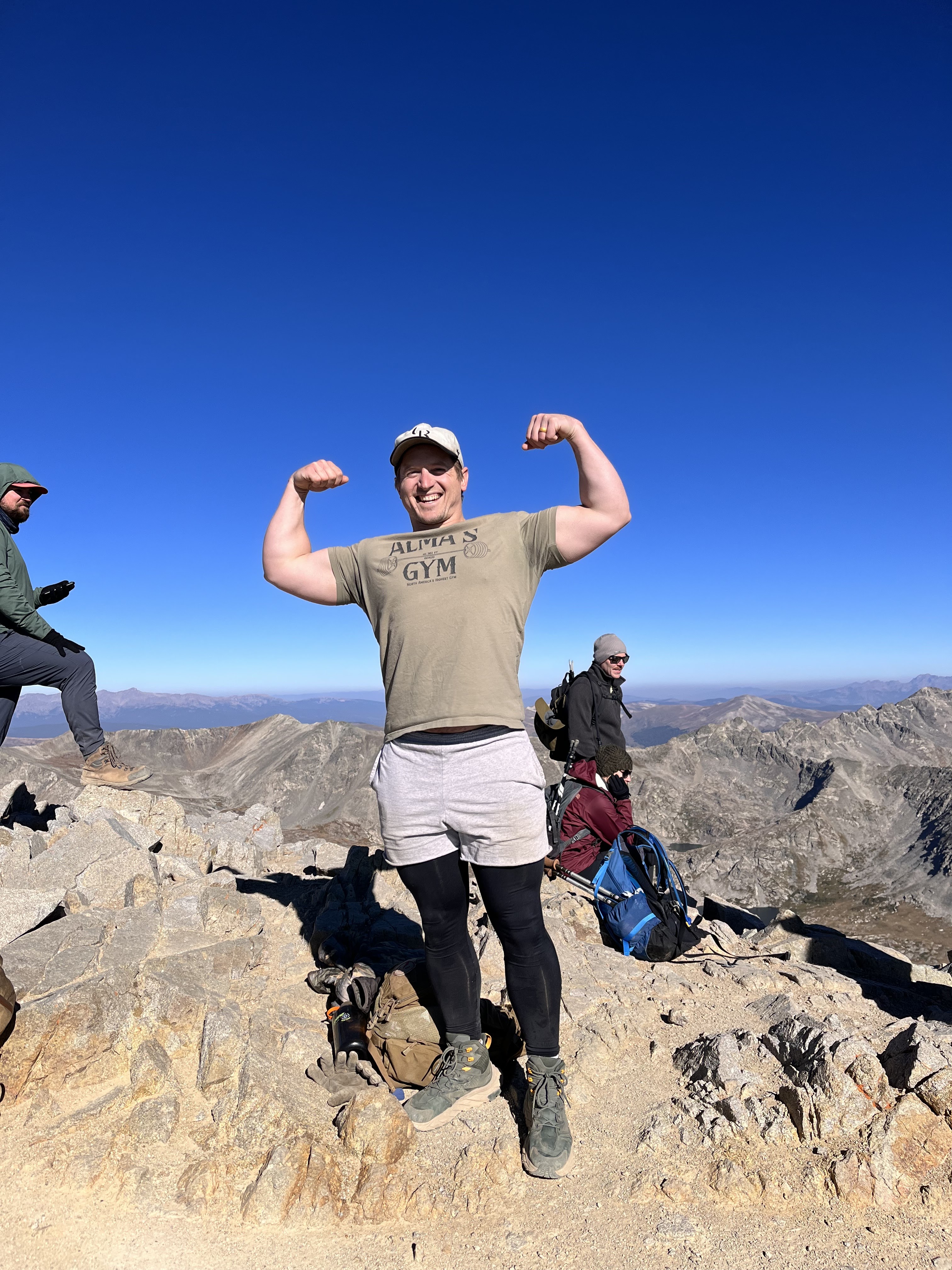
13,920 feet above elevation.

Conditioning is Optimal.

Min-maxing your physicality doesn’t work by avoiding weaknesses and maximizing your rest or doing as little as arbitrarily deemed necessary to garner a minimal response while convincing yourself that you’re maxing your genetic potential (which you truly do not know).

Chances are, you don’t know what hard is. Yet.

Especially if you have been avoiding conditioning work or have never pushed a muscle to absolute failure in both the concentric and eccentric range of motion (something that requires a very demanding and somewhat sadistic training partner).

But Mentzer and Yates did it!

I assure you, whatever it is you think you are doing it is not what they did. For as much obsession about training optimization that I see from the natty-for-life camp, those diet lettuce boys sure do like to point to two steroid using giants to rationalize their misinformed training decisions and utter lack of trying. For such optimalists, what is optimal is defined by what is easiest and quickest. Avoiding the difficult and confusing it with easy is their goal.

And no, the Pareto Principle is not going to apply to your halfhearted four hours of exercise each week. Try as you might, justifying your lack of effort by explaining a cost to benefit analysis will only lead to stagnation and eventual eviction from the process of training altogether.

But my recovery.

My central nervous system.

My fatigue.

Your excuses.

They are keeping you small, weak, and unfit.

So, do more.

            The best way to do more is to focus on training aspects that are directed towards that goal, which for most people is conditioning. That is how you can get more out of your training in less time – by doing more, faster.

            To preemptively obliterate the objections from the “aesthetic” minded 125-pound scrawny self-proclaimed bodybuilders who are always chasing “optimal”: No, conditioning doesn’t prevent hypertrophy. You can do lots of conditioning and become incredibly jacked.

Nearly 18" arms weighing about 190 pounds, without rest days.

            For most, more training is optimal, not less. If you are dissatisfied with your results, chances are you are not training enough, or eating, sleeping, destressing, and other similar means of actual recovery. So, try doing more of those things that require effort and consistency; things which simply not working out is not. Stressing over online gaming matches while surviving on Soylent and Bangs and sleeping five hours a night is not optimal. Try improving those habits before spending the next three weeks crafting a spreadsheet for the optimal training program.

            There is no “hack” to an impressive physique or physical ability. Wasting your time scouring the internet for such a one-weird-tricks is not optimal. Strength and conditioning, done frequently and with quality effort, in the traditional means I describe, is.

Conclusion

            I write this because I have seen this problem and can present a reasonable solution. Dismissing or deprioritizing conditioning was something that I began to do as I got more into powerlifting. That was a mistake. Partly because my sessions began to take very long. Partly because my lack of general fitness for the sake of sport specific adaptation led to recurring injuries; some of which I continue to deal with. Conditioning addresses both of those problems. I do care about your physical development, and I wish for you to not make the same mistake.

             Lastly, because I practice what I preach, below are some recent conditioning workouts of mine (in addition to the two deadlift-based ones I described previously in this post). Take inspiration from these and build for yourself your own conditioning workouts based on the concepts described above. Mind you, I am not the most fit, or the strongest individual. But, as an example, I recently hiked the Decalibron Loop; a hike that summits four 14,000-foot mountains, has over 3,000 feet of elevation, and is about seven miles. Within two hours of finishing I completed a 1,240 pounds powerlifting total with pounds left off the bar. For context: That’s about 287 pounds less than my best powerlifting meet total. All without peaking, or training specifically for the squat, bench, and deadlift.

Atop Mt. Lincoln. 14,291 feet/4356 meters.

Examples of recent conditioning workouts from my log:

1.     Ten Rounds as fast as possible of overhead press x5 reps and Concept2 Row 250m.

My results: Press weight 105 lbs. Time: 18:18. This was at a moderate pace, and my row is not that great anyways. I have also done this for longer and heavier: 60-minute AMRAP, Row 250m + Push Press 113 lbs. x5 reps. 31 rounds total +97m row.

2.     25 Minutes, As Many Rounds As Possible, of Muscle Cleans x5 reps, Pull Ups x5 reps, and Decline Sit-Ups x10 reps.

My Results: Muscle Clean weight 95 lbs. 20 rounds completed.


3.     25 Minutes, As Many Rounds As Possible, of Bench Press and 250m Concept2 Row.


My Results: Bench weight 185 lbs. 12 rounds plus one round of bench and 157m row.


4.     10 Minutes, As Many Reps As Possible, D. Ball over Shoulder.


My Results: Ball weight 45 lbs. Total reps: 147.

      *This was one portion of a workout done the day before the Decalibron hike.


5.     50 Rounds as fast as possible of 30 (15 per leg) 15-inch step-ups and 3 pull-ups. All wearing a 20-pound pack.


My Results: 1:09:58 for a total of 150 pull ups and 1,500 step ups, equaling 1,875ft of elevation gain.

      *This sucked.


Rest days: a conspiracy of the frail.